

Hard Water, Wastewater and Beyond | Commercial Water Treatment in India
Walk into any well-run hotel, hospital, or manufacturing facility in India and you will find one thing in common, a serious, deliberate approach to water management. Not because water treatment is glamorous, but because ignoring it is expensive. Damaged equipment, failed audits, rising operational costs, and compromised output quality are all symptoms of the same underlying problem: untreated water.
The good news is that the solutions available today are more advanced, more affordable, and more accessible than ever before. Commercial RO Plants, Water Softeners, and STP Plants now form the three pillars of a complete water management strategy for any serious facility. Understanding how each one works and when you need each one is the difference between a reactive maintenance culture and a proactive operational advantage.
This guide covers all three, from the technical fundamentals to real-world applications and practical maintenance advice.
Water Quality Education: Three Problems, Three Solutions
Most water quality challenges in commercial and industrial settings fall into one of three categories. Each demands a different treatment approach.
The Problem with Dissolved Impurities
The municipal and borewell water across India routinely carries dissolved salts, heavy metals, nitrates, and other contaminants that majorly cannot be filtered. Which in result affects the taste, safety, and integrity of any process that uses water as an input. And this is where a Commercial RO Plant becomes essential, removing dissolved solids at the membrane level to deliver water that meets the purity standards market facility demands.
The Problem of Water Hardness
Calcium and magnesium ions are the primary culprits behind hard water and hard water is one of the most underestimated operational costs in Indian industry. Scaling in boilers, cooling towers, pipelines, and heat exchangers quietly drives up energy consumption, shortens equipment life, and increases maintenance frequency. Water Softeners address this problem directly, replacing hardness-causing ions with sodium ions through an ion exchange process that protects your infrastructure.
The Problem of Wastewater
Every facility generates wastewater. Left untreated and discharged irresponsibly, it creates regulatory, environmental, and reputational risk. STP Plants treat wastewater to the point where it can be safely discharged or, in many cases, recycled back into non-potable facility uses such as landscaping, flushing, and cooling tower makeup water.
Technical Guide: Learn how the system Works
How a Commercial RO Plant Works
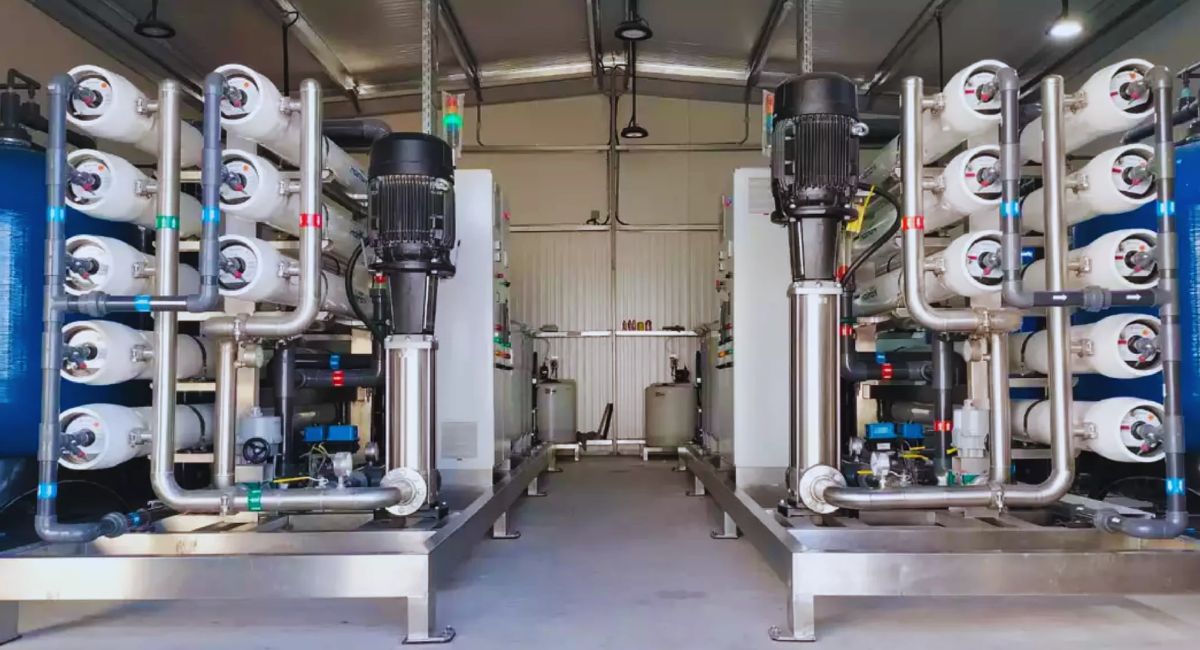
A Commercial RO Plant under pressure forces water through a semi-permeable membrane that blocks dissolved solids, bacteria, viruses, and chemical contaminants while allowing purified water to pass through. In a commercial setting, this process is usually scaled to meet high daily demand volumes, with automated monitoring systems managing pressure, flow rates, and output quality in real time. Pre-filtration stages protect the membrane from sediment and chlorine damage, while post-treatment stages tailor the output to the specific application.
How Water Softeners Work
Water Softeners operate on the principle of ion exchange. Hard water passes through a resin bed loaded with sodium ions. As the water moves through, calcium and magnesium ions attach to the resin and sodium ions are released in their place, producing softened water that no longer causes scale. The resin bed regenerates periodically using a salt brine solution, restoring its ion exchange capacity. Modern Water Softeners are equipped with automatic regeneration cycles that minimise salt and water consumption while maintaining consistent softening performance.
How STP Plants Work
STP Plants treats the wastewater through a series of biological, physical, and chemical processes. Primary treatment focuses on removing the suspended solids and floating matter. Secondary treatment focuses on breaking down organic matter using microbial activity. Tertiary treatment further polishes the effluent through filtration and disinfection, producing treated water suitable for safe discharge or reuse. Modern STP Plants are designed to be compact, energy-efficient, and low-maintenance, making them viable for facilities of all sizes.
Industry Insights: Who Needs What and Why
Hotels and Hospitality
A full-service hotel has a complex water demand profile. Guest rooms need soft, scale-free water for showers and laundry. Kitchens and restaurants need purified water meeting drinking standards. The facility as a whole generates significant wastewater daily. The complete answer is a combination of a Commercial RO Plant for potable and kitchen water, Water Softeners for laundry and HVAC systems, and an STP Plant to manage and recycle wastewater, reducing freshwater dependency and meeting local discharge norms simultaneously.
Educational Institutions and Residential Complexes
Large campuses and residential societies face similar challenges at scale. High daily water consumption, hard water complaints from residents, and mounting pressure to manage wastewater responsibly all point toward the same integrated approach. A lot of progressive housing societies are now investing in STP Plants specifically in order to recycle the treated water for common area irrigation and flushing, delivering meaningful reductions in freshwater usage and utility bills.
Manufacturing and Processing Facilities
A Commercial RO Plant ensures process water meets quality specifications. Water Softeners protect boilers, cooling towers, and heat exchangers from scaling that reduces efficiency and accelerates wear. STP Plants manage the effluent generated, keeping the facility compliant with pollution control norms and positioning it for responsible industrial citizenship.
Case Study: An Integrated Water Strategy for a Mid-Size Hotel in Telangana
A 120-room business hotel in Telangana was managing three separate water problems and none of them well. Guest complaints about hard water affecting skin and hair were persistent. The laundry operation was consuming excessive detergent and still delivering substandard results. Kitchen water quality was inconsistent. And the facility had no mechanism for treating or reusing the significant volume of wastewater it generated daily.
A full water audit revealed borewell water with TDS levels above 900 mg/L and hardness readings that were among the highest the assessment team had encountered in the region.
The solution was integrated rather than piecemeal. A Commercial RO Plant was installed to supply the kitchen, drinking water points, and guest floor water coolers. Water Softeners were deployed specifically for the laundry operation, housekeeping supply lines, and HVAC systems. A compact STP Plant was commissioned to treat all wastewater generated by the property, with treated water redirected to the facility’s landscaping and flushing systems.
Within one year, detergent consumption in the laundry dropped noticeably. Guest complaints about water quality ceased almost entirely. The facility’s freshwater draw from the borewell reduced significantly as treated wastewater covered a meaningful share of non-potable demand. The STP Plant also brought the property into full compliance with local municipal discharge regulations, eliminating a regulatory exposure that had previously gone unaddressed.
Maintenance Tips: Protecting Your Water Treatment Investment
Commercial RO Plant
Replace pre-filters every three to six months without exception. Monitor output TDS regularly, as any upward drift signals membrane stress before it becomes membrane failure. Schedule a full system service annually, including pressure checks, membrane inspection, and a review of automated controls.
Water Softeners
Check salt levels in the brine tank monthly and refill before the tank runs dry. Allowing the resin to operate without salt accelerates hardness breakthrough. Inspect the resin bed annually for fouling or degradation. If your incoming water has high iron content, consider a dedicated iron pre-filter to protect the resin from iron fouling, which significantly shortens its service life.
STP Plants
The biological stage of an STP Plant depends on a healthy microbial population. Avoid discharging high concentrations of disinfectants, antibiotics, or toxic chemicals into the system, as these disrupt the biological process and can cause treatment failures. Inspect aeration equipment regularly, as aeration is the heart of biological treatment. Have the treated effluent quality tested against discharge standards at least twice a year to confirm the system is performing within compliance parameters.
The Bottom Line
Commercial water treatment is not a single product decision. It is a system decision. A Commercial RO Plant addresses dissolved impurities. Water Softeners protect your infrastructure from the slow, expensive damage of scale. STP Plants close the loop on wastewater, turning a liability into a resource.
Facilities that treat these three as separate problems typically end up with three separate headaches. Facilities that approach them as an integrated water management strategy, with the right partner guiding specification, installation, and maintenance, find that the whole is significantly greater than the sum of its parts.
Aquastag designs, installs, and maintains all three systems. If you are ready to take water quality seriously, it starts with a free assessment of what you are actually working with.